Susan McGahern’s Breast Cancer Diagnosis and Treatment
The Greatest Beer Run Ever: A Memoir of Friendship, Loyalty, and WarSusan McGahern’s breast cancer diagnosis and treatment set a private medical crisis against the children’s bewilderment at her repeated absences. The illness brought surgery and deep X-ray treatment, but also decisions about work, a new home, and who would be told what. In John McGahern’s recollection, the struggle is marked by the contrast between Susan’s efforts to preserve her independence and the secrecy with which her husband managed her prognosis.
Diagnosis and the children’s uncertainty
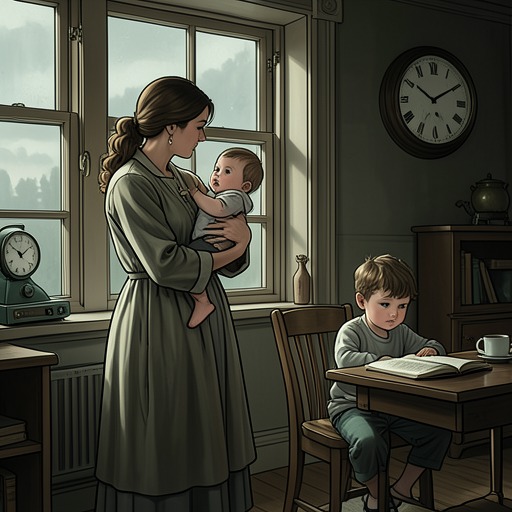
Susan was diagnosed with breast cancer and kept in the Mater Hospital in Dublin for several weeks of tests and treatment. During her first long stay away, her children were living in the barracks under their father’s direct rule. They did not know where she was or what had happened to her; when they asked, they were told not to ask and to pray. Susan, however, knew that John was beginning to see through the concealment. In a letter to her husband, she wrote, “Sean is beginning to have more sense and will not be put off as easily as the others about my whereabouts. Well, thank God I will soon be home with you all again, looking forward to that is making me better.” The letter makes clear that the children’s uncertainty was not simply a consequence of separation: it was maintained by the adults around them, even as Susan looked toward returning to them.
She came home briefly for the birth of Dympna, then left again, with the baby placed in the care of Bridgie McGovern. John’s sharpest memory of that short return was travelling with his father in Packie McCabe’s car to bring Susan and the baby home from a nursing home in Boyle. Wartime restrictions had taken private cars off the roads; the family’s small Ford was resting on blocks in a barracks shed. Susan carried Dympna in a white shawl, while the baby’s red hair and Packie’s red hair prompted laughter that the boy could not understand. After about a week at the barracks, Susan was gone again, and the children still did not know where she had gone.
Treatment, work, and the move to Aughawillan
Susan’s illness prompted her relatives to find her a teaching post closer to the town and to people who could help her. Her previous schools at Beaghmore and the bog of Cloone and Carrigallen were too far away. While she was still in hospital, her sister Maggie and brother Pat McManus helped secure a permanent position at Aughawillan School, a two-teacher school on a hill three miles from Ballinamore. A house and farm at Corramahon were also for sale, only a ten-minute walk from the school; Garradice Halt, with trains to Ballinamore, lay between the house and school. A priest agreed to hold the teaching position until Susan could leave hospital.
She was also offered her former position at Lisacarn School, but chose Aughawillan. In letters to her husband she could be conciliatory, yet on this decision she was definite: “No,” she underlined. “I do not need a sub in Beaghmore. Aughawillan is what concerns me now.” Once permitted out of hospital, she intended to teach at Aughawillan for a day to secure the position, arrange for a substitute, and return to the Mater Hospital for the remainder of her treatment. Her plan joined work to recovery: she would not give up her profession simply because she was ill.
Her husband initially opposed buying the Corramahon property, both because it required spending money and because he suspected her relatives’ influence. He also saw it as an investment. The alternative was for Susan to retire on a small pension and move with the children into the barracks, which would have brought the family together under one roof. Her relatives opposed that option. They knew her husband’s character and feared that she would surrender the independence she had earned through schooling and training, placing herself and the children in his volatile care. Susan was cautious about the property purchase, writing that she had not seen the house and hoped he had not yet invested. She had more immediate concerns while treatment continued.
The prognosis and its concealment
Her husband sought medical advice in writing, asking whether Susan should give up teaching and what her chances of recovery were. He had already received a detailed report early in the illness. The doctor replied on 8 December 1942 that Susan should continue teaching while in good health and stop only on medical advice, adding that she would probably be happier working than otherwise. The prognosis was grave: the growth was highly malignant, and without treatment she would not have survived beyond a year from the doctor’s first examination. Radical surgery followed by thorough deep X-ray treatment gave her the maximum hope available, but only a 30 percent chance of complete recovery. The doctor advised against taking on financial liabilities in the expectation that she would recover.
Her husband communicated neither this assessment nor the earlier report to Susan or anyone else. He nevertheless bought Corramahon, using the money from selling his homeplace at Gowna to pay most of the cost. The withheld prognosis therefore shaped the family’s decisions without being openly shared with the person whose health was at stake. The move could look like an investment or a route to family life together, but Susan had to plan her work and treatment without the full medical information her husband possessed.
In September, allowed out of hospital for a few days, Susan saw her new home for the first time. She travelled alone by train to Dromod, where Pat McManus met her, and stayed with him and Maggie at their shop in Ballinamore. Her visit was too short for the barracks; she said it would be too hard to leave once she was there. Her husband did not visit her, although Cootehall was only eighteen miles away. When the school reopened, Pat drove her to Father McEntee’s house in Aughawillan at eight in the morning. Pat insisted that the priest receive a five-pound offering, the amount paid to the surgeon for Susan’s operation. The unofficial payment helped secure the post. Susan signed the forms, joked about being late for school, and began the work that she had determined to keep.
Renewed symptoms and the approach of death
For a time, Susan returned to school when she felt better. Then she wrote of being back at work after several days in bed, improved but still suffering, and hoped that better weather and sunshine might help. The letter ends with the words “God is great.” Behind that endurance lay her suspicion that the cancer had returned. Stomach pain and recurrent constipation and diarrhoea were presented to her as an unrelated illness from which she could recover if she made the effort. Those around her, in the narrator’s account, helped push her away from the possibility she feared. She asked her husband to write to Dr Corcoran in Dublin; he was reluctant, having already contacted the doctor secretly.
The doctor came by bicycle for one final visit. He spent the time in grave conversation with Susan, while the children were not allowed to accompany them. When he left, she was able to walk him to the little iron gate at the road. They were never to see one another again. The episode’s quietness makes the absence of explanation consequential: the children saw the visit, the closed conversation, and the farewell at the gate, but were excluded from its meaning.
Susan continued to imagine a near future in which a substitute teacher would take over and she could use the weeks before the long holidays to recover. John’s retrospective account places that ordinary plan beside the reality she was approaching. He describes how the world of everyday work and errands can become, for the dying, an inaccessible realm of happiness. The contrast between Susan’s practical hopes and the family’s unspoken knowledge exposes the cost of treating death as something that must be hidden or denied.
Faith, family, and the meaning of the illness
Prayer was woven into the family’s daily life: work stopped for the Angelus, and the day ended with the Rosary. At Corramahon, the children and Susan knelt by the fire before going upstairs to pray. Church ceremonies also gave John an early experience of beauty and mystery, and he later described the Church as a source of meaning beyond his father’s authority. This religious world could offer language and ritual in a household where the facts of Susan’s illness were withheld, but it could not remove the physical pain or the fear of leaving those who depended on her.
Susan’s faith, John reflects, must have been a strength; her husband nevertheless accused her of losing faith in God. The accusation sits uneasily beside her own letter ending in trust and her continued attention to work, home, and children. Her diagnosis and treatment are therefore not presented as a medical episode alone. They reveal the unequal distribution of knowledge within the family, the relatives’ practical support for her independence, and the limits of consolation when the person who is ill cannot openly share what she knows or fears.